[fusion_builder_container type=”flex” hundred_percent=”no” equal_height_columns=”no” hide_on_mobile=”small-visibility,medium-visibility,large-visibility” background_position=”center center” background_repeat=”no-repeat” fade=”no” background_parallax=”none” parallax_speed=”0.3″ video_aspect_ratio=”16:9″ video_loop=”yes” video_mute=”yes” border_style=”solid”][fusion_builder_row][fusion_builder_column type=”1_1″ type=”1_1″ background_position=”left top” border_style=”solid” border_position=”all” spacing=”yes” background_repeat=”no-repeat” margin_top=”0px” margin_bottom=”0px” animation_speed=”0.3″ animation_direction=”left” hide_on_mobile=”small-visibility,medium-visibility,large-visibility” center_content=”no” last=”no” hover_type=”none” min_height=”” link=””][fusion_text]
Introduction
It’s hard to imagine a world without websites — where brands couldn’t exist online, news wasn’t just a click away, and information wasn’t instantly available. Yet, the story of websites is a relatively young one, unfolding over just a few decades. From a simple text-based page created by a scientist at CERN to billions of dynamic, interactive sites today, the web’s journey reflects human creativity, technological ambition, and the power of connection.
In this article, we’ll explore the history of websites, tracing their evolution from the early 1990s to today’s AI-powered, design-driven era
The Birth of the Web (1989–1993)
The internet existed long before websites did. In the 1960s and 70s, government and academic institutions built interconnected computer networks such as ARPANET, which allowed data to be shared between machines. But this system was technical, fragmented, and designed for researchers — not the public.
Everything changed in 1989, when Sir Tim Berners-Lee, a British scientist working at CERN (the European Organization for Nuclear Research), proposed a new idea: an information system that could connect documents using hyperlinks. His vision was simple yet revolutionary — a “web” of information anyone could access with a browser.
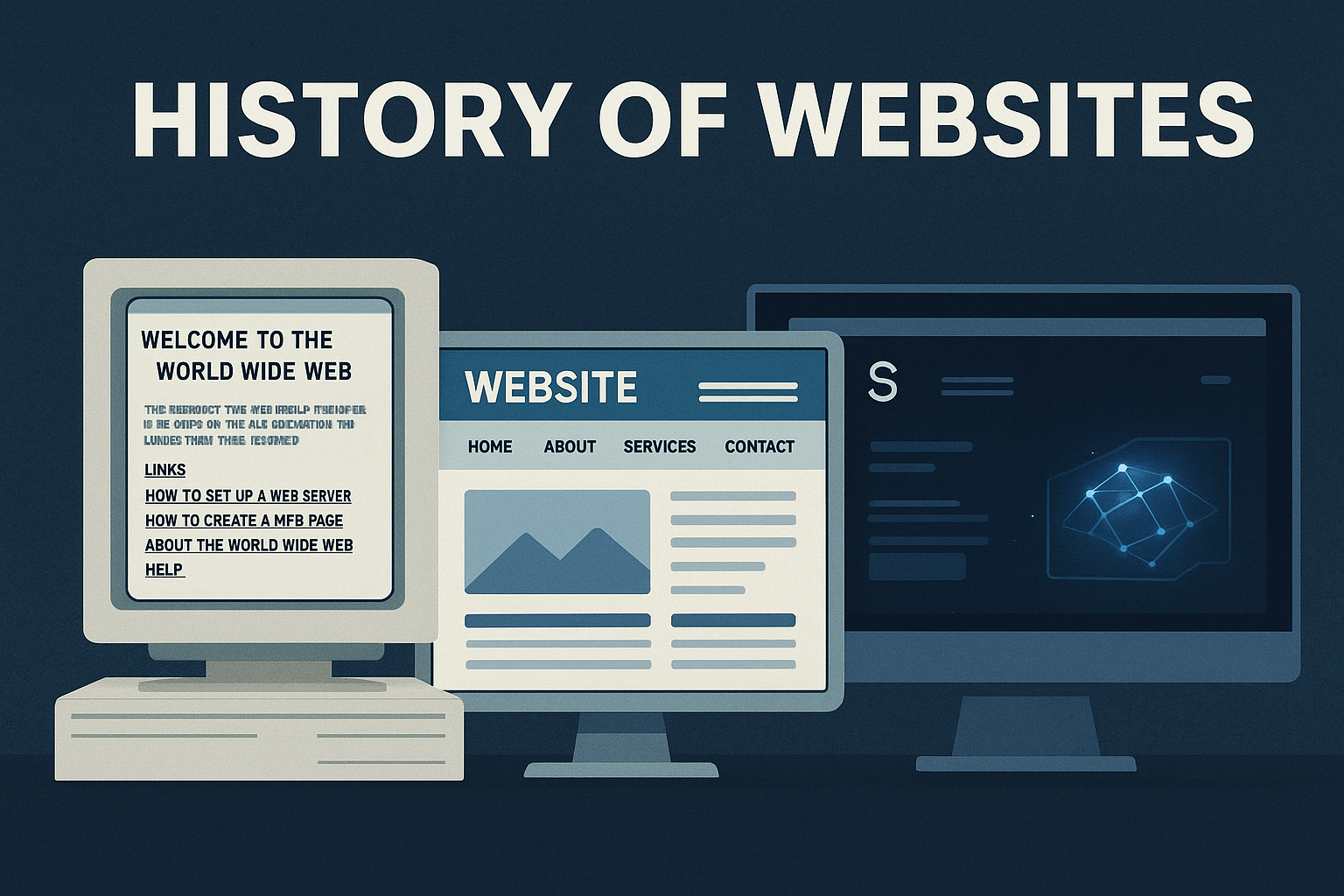
By 1991, Berners-Lee had launched the first website in the world, hosted on the CERN servers. It was a plain text page explaining what the World Wide Web was, how to use it, and how others could build their own pages. It had no images, colors, or styling — just words and links. But that single page marked the birth of the modern internet.
The Rise of the Browser (1993–1995)
The early web would have stayed limited to academics had it not been for the invention of web browsers. In 1993, a team at the National Center for Supercomputing Applications (NCSA) released Mosaic, the first browser that could display both text and images together.
Mosaic’s graphical interface transformed the web from a text-only system into a visual experience. Soon after, one of Mosaic’s developers, Marc Andreessen, co-founded Netscape Communications and launched Netscape Navigator in 1994.
Netscape became a sensation — millions of users downloaded it, and businesses began to realize the commercial potential of having a presence online. The dot-com boom had quietly begun.
During this time, HTML (Hypertext Markup Language) became the standard for building pages, and HTTP (Hypertext Transfer Protocol) became the language for transferring data between servers and browsers. The web was taking shape as a universal platform.
The Dot-Com Boom and Early Business Websites (1995–2000)
By the mid-1990s, websites had become a digital gold rush. Entrepreneurs, large corporations, and even small shops wanted to get online. Suddenly, every company needed a website — even if it was just a digital brochure.
Some of today’s biggest tech giants were born during this era:
- Amazon (1994) started as an online bookstore.
- eBay (1995) launched online auctions.
- Yahoo! (1995) organized the web with searchable directories.
- Google (1998) redefined how users found information.
The design of websites was still basic — limited by slow dial-up connections and primitive coding tools. Web pages were mostly HTML tables, animated GIFs, and bright backgrounds. Still, this was the first time businesses realized that websites could attract global audiences.
The dot-com bubble of the late 1990s encouraged thousands of startups to create websites, promising revolutionary online services. While many of those companies failed when the bubble burst around 2000, their ambition permanently changed how we viewed the internet — as a marketplace of ideas, commerce, and innovation.
Web 2.0 – The Interactive Internet (2001–2008)
The early 2000s introduced a new era known as Web 2.0. Unlike static pages that simply displayed content, Web 2.0 sites allowed users to interact, share, and contribute.
This era birthed social media and user-generated content. Websites like:
- Wikipedia (2001) opened knowledge to the public.
- MySpace (2003) and Facebook (2004) made personal profiles mainstream.
- YouTube (2005) turned video into a universal form of expression.
The technology behind this transformation included JavaScript, AJAX, and CSS, which allowed dynamic updates and styling without refreshing entire pages. Websites became more fluid, responsive, and creative.
Design trends also changed — glossy buttons, gradient backgrounds, and interactive menus became popular. Web designers began to merge art and technology, laying the foundation for modern UI/UX design.
Businesses adapted too. Having a website was no longer optional; it became the digital front door. Online Marketing, Search Engine Optimization (SEO), and Pay-Per-Click (PPC)advertising emerged to drive visibility and conversions.
The Mobile Revolution (2008–2015)
The next major leap came with the smartphone era. When Apple introduced the iPhone in 2007, and Android followed soon after, the way people accessed the internet fundamentally changed.
For the first time, users didn’t need a computer to browse the web — they could do it from their pockets. This shift forced websites to become mobile-friendly.
Initially, many companies built separate mobile versions of their websites, often with limited functionality. But this created inconsistency and maintenance challenges.
In response, developers embraced responsive web design, a technique introduced by Ethan Marcotte in 2010, where a single website automatically adjusted to any screen size.
This revolution also inspired app-like experiences within browsers, known as progressive web apps (PWAs). The lines between websites and mobile applications began to blur.
The Age of Design, SEO, and Performance (2015–2020)
By the mid-2010s, websites evolved beyond just being functional — they became expressive digital identities.
Modern design trends emphasized minimalism, bold typography, and storytelling. Clean layouts, fast loading times, and strong branding became essential.
At the same time, search engines became the primary gateway to the web. Google refined its algorithms, rewarding websites that offered speed, security, and valuable content. This gave rise to SEO (Search Engine Optimization) as a vital business strategy.
Frameworks like WordPress, Wix, and Shopify democratized web development. Anyone — from a freelancer to a multinational brand — could create a professional website without needing to code from scratch.
Web technologies such as HTML5, CSS3, and JavaScript frameworks (React, Angular, Vue) pushed the limits of interactivity. Video backgrounds, parallax scrolling, and AI chatbots became mainstream features.
In this period, websites transformed into full-fledged experiences — combining storytelling, automation, and design to capture user attention in seconds.
The Modern Web: AI, Interactivity, and Beyond (2020–Present)
Today’s websites are far from static pages. They are intelligent systems powered by AI, machine learning, and automation. From personalized recommendations to conversational chatbots, modern websites adapt to users in real time.
The rise of Answer Engine Optimization (AEO) — ensuring your website surfaces as the top “answer” in voice or AI searches — marks the next step in SEO evolution. With voice assistants and AI search tools becoming the norm, websites now need to think beyond traditional keywords.
Visual aesthetics have also evolved. Modern web design embraces neumorphism, dark mode, micro-animations, and immersive storytelling. User experience (UX) is now a core business asset.
Security and speed have become equally crucial. Technologies like SSL encryption, lazy loading, and content delivery networks (CDNs) ensure websites remain fast and trustworthy.
Moreover, AI-powered website builders like Wix ADI, ChatGPT plugins, and other automation tools allow creators to generate layouts, content, and design suggestions in seconds — democratizing web creation like never before.
The Future of Websites
The next chapter of the web is being written right now. We’re moving toward Web 3.0, a decentralized and intelligent version of the internet. It envisions websites built on blockchain, integrated with smart contracts, cryptocurrency payments, and secure digital identities.
Meanwhile, AR (Augmented Reality) and VR (Virtual Reality) promise to turn websites into immersive environments. Imagine browsing a virtual showroom, walking through a 3D property tour, or interacting with a digital assistant in real time.
AI will continue reshaping content creation, search optimization, and customer interaction. Businesses that embrace these technologies will define the next generation of the internet.
Why Understanding Web History Matters
Knowing where websites came from helps us understand where they’re headed. The evolution of the web mirrors the evolution of human communication — from static words to interactive worlds.
For businesses, this history carries an important lesson: Adapt or be left behind.
The web has always rewarded innovation — from text to images, from mobile to AI. Companies that embrace modern technology and user-centric design will continue to thrive.
At Emm Kay Customs, for example, we’ve seen this transformation firsthand. The journey from early HTML pages to today’s dynamic, AI-enhanced platforms shows that web presence is not just about being online — it’s about creating meaningful digital experiences that connect, inform, and inspire.
Conclusion
The history of websites is more than a timeline of code and technology — it’s the story of how humanity built a digital universe. In just over 30 years, we’ve gone from a single page at CERN to a living, breathing web of over a billion websites, each one shaping how we learn, shop, work, and dream.
As we enter an era driven by artificial intelligence, personalization, and immersive design, one truth remains constant: the web will always evolve — and so must we.
[/fusion_text][/fusion_builder_column][/fusion_builder_row][/fusion_builder_container]