[fusion_builder_container type=”flex” hundred_percent=”no” equal_height_columns=”no” hide_on_mobile=”small-visibility,medium-visibility,large-visibility” background_position=”center center” background_repeat=”no-repeat” fade=”no” background_parallax=”none” parallax_speed=”0.3″ video_aspect_ratio=”16:9″ video_loop=”yes” video_mute=”yes” border_style=”solid”][fusion_builder_row][fusion_builder_column type=”1_1″ type=”1_1″ background_position=”left top” border_style=”solid” border_position=”all” spacing=”yes” background_repeat=”no-repeat” margin_top=”0px” margin_bottom=”0px” animation_speed=”0.3″ animation_direction=”left” hide_on_mobile=”small-visibility,medium-visibility,large-visibility” center_content=”no” last=”no” hover_type=”none” min_height=”” link=””][fusion_text]
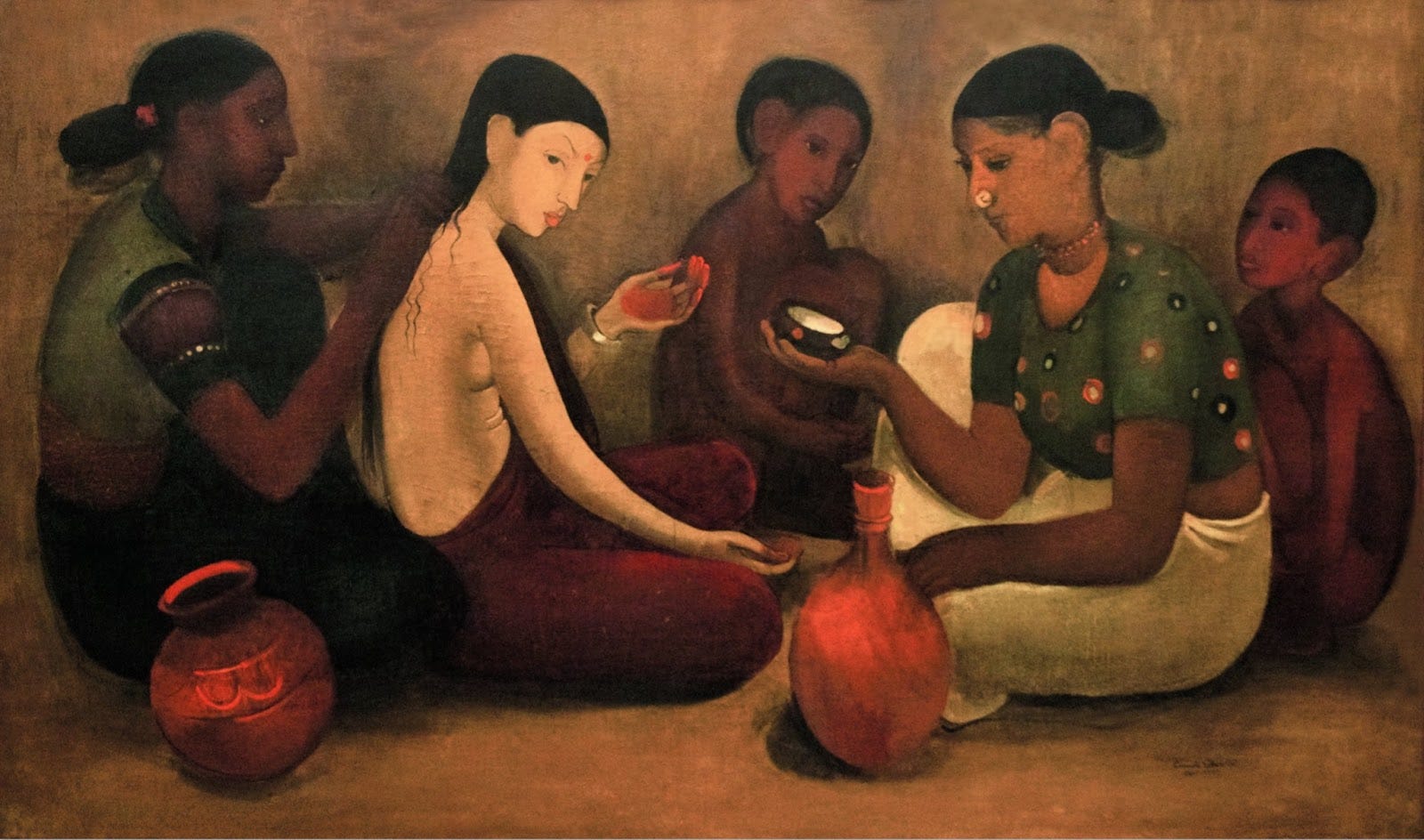
Many art historians and critics point to Bride’s Toilet (1937) as one of Amrita Sher-Gil’s most important and mature works — a painting that crystallises her move from European-trained modernist toward an artist deeply engaged with Indian subject matter, visual traditions, and social feeling. Bride’s Toilet is part of Sher-Gil’s celebrated South Indian trilogy and is in the collection of the National Gallery of Modern Art, New Delhi. Wikipedia+1
Below is an original, in-depth article about Bride’s Toilet — its history, visual language, themes, technique, cultural context and legacy — written for your website. (This piece is freshly composed and not copied from any single source.)
Introduction — a painting that changed the course of modern Indian art
Painted in 1937, Bride’s Toilet marks a decisive moment in Amrita Sher-Gil’s career. After training in Paris and being exposed to European modernism, Sher-Gil returned to India with a transformed purpose: to create a new visual language that married Western formal training with indigenous subject matter and traditions. Bride’s Toilet shows her fully inhabiting that hybrid language — the formal restraint and compositional control of modernism combined with narrative intimacy and the rhythms of Indian fresco and miniature painting. It is precisely this synthesis that causes many critics to single it out as one of her masterpieces. Wikipedia+1
Historical and biographical context
Amrita Sher-Gil (1913–1941) was born into a cosmopolitan household — Hungarian mother, Sikh-Punjabi father — and trained in Europe, most notably at the École des Beaux-Arts-influenced ateliers of Paris. By the mid-1930s she had mastered the European language of line, volume, and colour, and had experimented with Post-Impressionist, Fauvist and Cézannian ideas. Her return to India in 1934 triggered a radical reorientation. Instead of continuing as an expatriate modernist, she set out to translate her training into a visual idiom that could represent Indian people and life with both dignity and modern formal clarity.
Bride’s Toilet belongs to a phase of work Sher-Gil produced after spending time in South India in 1937. The painting is usually grouped with Brahmacharis and South Indian Villagers Going to Market as part of a “South Indian trilogy” in which she turned her focus to rural life, ritual, and the inner worlds of women. The immediate context — the visual memory of Ajanta frescoes, the flattened yet monumental treatment of figures, and an engagement with local rituals — all feed into the power of Bride’s Toilet. Wikipedia+1
What the painting shows — description without interpretation
At first glance Bride’s Toilet is a quiet, intimate domestic scene. The central figure — the bride — sits half-dressed and vulnerable, her palms stained with mehndi (henna). She is flanked by two women and two children who attend to her, arranging hair or holding vessels. Faces are calm, almost expressionless; bodies are poised but not theatrical. The room is suggested by flattened planes and patterned surfaces rather than fully modelled space, giving the scene both an immediacy and an archetypal quality.
Colour is rich but controlled: warm earth tones, ochres and muted reds ground the composition, while punctuations of white, green or blue create counterpoints. The overall effect is both intensely intimate and quietly monumental: a small ritual rendered with compositional gravitas. Wikipedia
Formal analysis — how Sher-Gil composes feeling
Composition and space
Sher-Gil arranges figures in a tiered, frontal fashion reminiscent of mural and miniature traditions: the scene reads as both narrative and tableau. She compresses spatial depth, preferring planar relationships over illusionistic recession. This flattening is not a weakness but a deliberate formal choice: it focuses the viewer’s attention on the relationships between figures, on ritual gestures and on the lyricism of line and plane.
Line and drawing
The artist’s draughtsmanship is disciplined. Contours are assertive but never heavy; a few economical strokes delineate limbs and drapery. There is a sculptural economy to the drawing — each line contributes to a calm geometry that structures the figures into a cohesive group.
Colour and tonal handling
Sher-Gil’s palette in Bride’s Toilet balances local colour sensibilities with modernist restraint. Earthy ochres and siennas give a sense of the sun-warmed interiors of rural India; darker tones anchor the composition while subtle highlights — the sheen of a vessel, the light on a cheek, the white of a cloth — provide an internal luminescence. The overall chromatic harmony lends the scene dignity rather than spectacle.
Gesture and expression
Faces in the painting are characteristically restrained — Amrita often painted women with pensive, inward gazes. This expressionless quality should not be read as emotional absence; instead, it creates a contemplative atmosphere where interiority is implied rather than declared. Ritual gestures — the dressing of hair, the holding of a pot — become the emotional grammar of the scene.
Sources and influences — Ajanta, Mughal miniatures and European modernism
Sher-Gil’s style in Bride’s Toiletsynthesises multiple strands. Art historians note the influence of the Ajanta frescoes — flattened figures, rhythmic line, and a serene monumentality — as well as Mughal and Rajput miniature traditions in the way she compresses narrative into decorative planes. From Europe she carried lessons of proportion, an understanding of volume, and a modernist discipline of form.
This intentional mixing produces a hybrid language that feels native and modern simultaneously: the monumentality and compositional restraint of frescoes, the intimate scale and narrative focus of miniatures, and the formal training of academic and modernist practice all cohere in Sher-Gil’s hand. Wikipedia+1
Themes — women, ritual, vulnerability and dignity
One reason Bride’s Toilet resonates so strongly is its humane focus on women’s lives. Sher-Gil repeatedly centred women — not as sensationalised figures but as psychological presences and social actors. In Bride’s Toilet she observes rites surrounding marriage: the preparation, the private moments before public ceremony, the mixture of ritual expectancy and domestic labour. The bride’s semi-nudity is not eroticised; it is candid and human, marking a liminal moment of transition.
There’s also social empathy in Sher-Gil’s eye: these are not aristocratic pageants but humble, rural rituals. The painting locates dignity in everyday work and private ceremony, elevating ordinary lives to the scale of modern art. In that sense the work can be read as both ethnographic and elegiac — a document of tradition and a meditation on modernity’s encroachments.
Technique and materiality
Executed in oil on canvas, Bride’s Toilet displays Sher-Gil’s command of oil technique: layered glazing where needed, confident impasto in focal areas, and economy in brushwork elsewhere. Her control of paint allows both surface richness and compositional clarity — the painted surface never overwhelms the image’s quiet narrative. The material choices support the painting’s dual identity: European medium, Indian subject — a physical manifestation of her artistic mission.
Reception and exhibition history
When Sher-Gil showed her Indian work in the 1930s, it attracted immediate attention. Bride’s Toilet was displayed publicly in Lahore in 1937 as part of a solo exhibition and later became part of the National Gallery of Modern Art (NGMA) collection in New Delhi. The painting’s presence in institutional collections and frequent inclusion in retrospectives has cemented its reputation as a touchstone of early modern Indian painting. Wikipedia+1
Why critics consider it her “best” (or one of her best)
The label “best” is always subjective, but several factors explain the frequent elevation of Bride’s Toilet in Sher-Gil’s catalogue:
- Synthesis of influences: the painting combines Ajanta-like monumentality, miniature flattening and modernist composition into a compelling new idiom. Wikipedia
- Emotional depth: Sher-Gil’s humane portrait of women’s ritual life resonates with modern audiences as a document of both private feeling and social reality.
- Technical mastery: confident handling of oil, disciplined drawing and harmonic colour show her technical maturity.
- Cultural resonance: as part of the South Indian trilogy, the painting signalled her commitment to an Indian modernism that rejected mere mimicry of Europe. Wikipedia
These qualities help explain why students of modern Indian art often single out Bride’s Toilet when surveying Sher-Gil’s contribution.
Legacy — influence on later generations and continued relevance
Amrita Sher-Gil’s tragic early death at 28 froze a remarkable trajectory, but the work she left behind — and Bride’s Toilet in particular — has had disproportionate influence. Post-Independence Indian artists and critics looked to Sher-Gil as a pioneer who proved that modern art could be rooted in Indian life without sacrificing formal rigor. The painting’s humanism, focus on women, and hybrid aesthetic continue to inspire contemporary artists exploring identity, gender and postcolonial narrative.
Moreover, Bride’s Toilet remains widely reproduced in academic and popular accounts of Indian modernism and continues to be a frequent highlight in NGMA exhibitions and catalogues, ensuring its visibility to new generations. Google Arts & Culture+1
How to view the painting today — museum and online access
Bride’s Toilet is in the National Gallery of Modern Art, New Delhi, where it is frequently included in Sher-Gil retrospectives and themed exhibitions about women in modern art. For researchers and readers outside India, high-quality reproductions and museum dossier entries (for example in Google Arts & Culture and NGMA publications) provide access to the painting and thoughtful curatorial notes. Wikipedia+1
Concluding thoughts — a painting that still speaks
Bride’s Toilet is not merely an object admired for formal qualities; it is an ethical act in paint. By turning her modernist grammar toward the private rituals of Indian women, Sher-Gil forged a picture that is at once intimate, dignified and formally innovative. The painting endures because it brings together skill and compassion, a learned technique and a deep sympathy for its subjects. For anyone interested in the birth of modern Indian art, Bride’s Toilet remains an essential work — both visually and historically.
[/fusion_text][/fusion_builder_column][/fusion_builder_row][/fusion_builder_container]