[fusion_builder_container type=”flex” hundred_percent=”no” equal_height_columns=”no” menu_anchor=”” hide_on_mobile=”small-visibility,medium-visibility,large-visibility” class=”” id=”” background_color=”” background_image=”” background_position=”center center” background_repeat=”no-repeat” fade=”no” background_parallax=”none” parallax_speed=”0.3″ video_mp4=”” video_webm=”” video_ogv=”” video_url=”” video_aspect_ratio=”16:9″ video_loop=”yes” video_mute=”yes” overlay_color=”” video_preview_image=”” border_color=”” border_style=”solid” padding_top=”” padding_bottom=”” padding_left=”” padding_right=””][fusion_builder_row][fusion_builder_column type=”1_1″ layout=”1_1″ background_position=”left top” background_color=”” border_color=”” border_style=”solid” border_position=”all” spacing=”yes” background_image=”” background_repeat=”no-repeat” padding_top=”” padding_right=”” padding_bottom=”” padding_left=”” margin_top=”0px” margin_bottom=”0px” class=”” id=”” animation_type=”” animation_speed=”0.3″ animation_direction=”left” hide_on_mobile=”small-visibility,medium-visibility,large-visibility” center_content=”no” last=”true” min_height=”” hover_type=”none” link=”” border_sizes_top=”” border_sizes_bottom=”” border_sizes_left=”” border_sizes_right=”” first=”true”][fusion_text]Introduction: A Star Born Too Early
Amrita Sher-Gil is a name that reverberates through the corridors of Indian and South Asian art history. Often referred to as the “Frida Kahlo of India,” Sher-Gil’s brief yet profound life left an indelible impact on modern Indian art. Her works are celebrated not just for their aesthetic brilliance but also for their cultural boldness and emotional intensity. Despite her untimely death at the age of 28, Amrita Sher-Gil’s legacy continues to inspire generations of artists, feminists, and cultural historians.
Her connection to Lahore—a city she once called home—is particularly poignant. It was in this vibrant cultural hub that Sher-Gil nurtured her vision, forged her identity, and painted some of her most evocative works. Today, her Lahore residence stands as a living testament to her legacy, now respectfully preserved by Emm Kay Customs, a forward-thinking company that believes deeply in the power of art and history.
Early Life and Heritage
Amrita Sher-Gil was born on January 30, 1913, in Budapest, Hungary, to a Sikh aristocrat father, Umrao Singh Sher-Gil Majithia, and a Hungarian-Jewish opera singer mother, Marie Antoinette Gottesmann. Her upbringing was one of duality—European sophistication mixed with Indian cultural roots. This unique blend shaped her perspective and would later define her groundbreaking artistic vision.
Sher-Gil showed signs of artistic talent from a very young age. Her parents, recognizing her natural inclination towards the arts, encouraged her to pursue formal education in painting. At age 16, she went to Paris to study at the prestigious École des Beaux-Arts.
The Paris Years: Training and Transformation
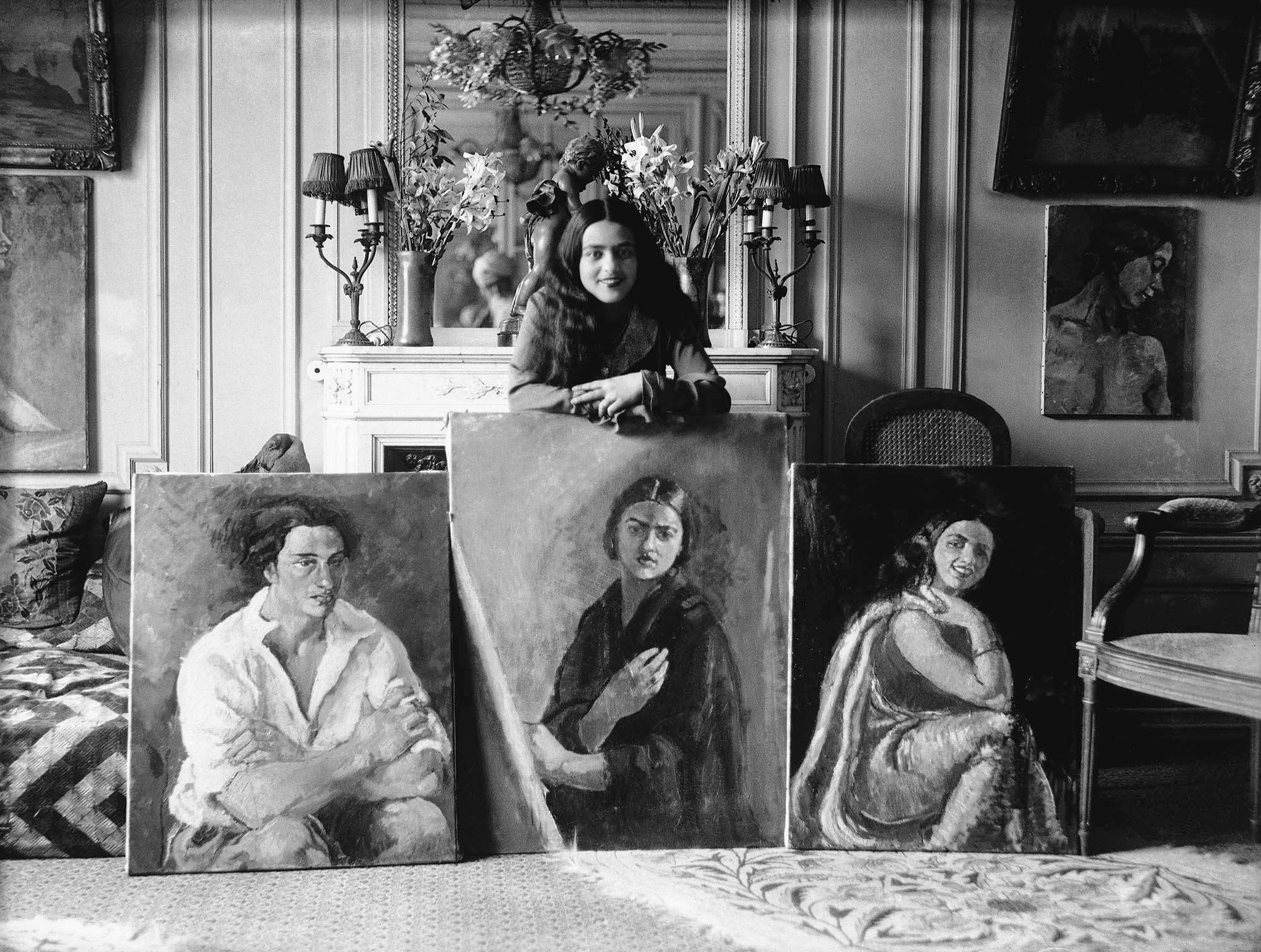
In Paris, Amrita immersed herself in classical European techniques, drawing influence from artists like Paul Cézanne, Paul Gauguin, and Amedeo Modigliani. Her early works reflected these Western styles—portraits, self-portraits, and nude studies that showcased not only technical brilliance but emotional depth.
During this time, she also developed a fascination with the self-portrait genre. Her portraits—most notably “Self-Portrait as a Tahitian”—were bold, confident, and deeply introspective. They challenged traditional depictions of women in art, confronting the viewer with Sher-Gil’s self-assured gaze.
But despite the acclaim she received in Europe, Amrita yearned for something deeper—a reconnection with her Indian roots.
Return to India: Finding Her Voice
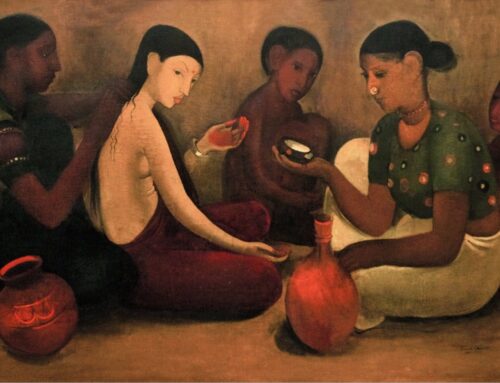
In 1934, Sher-Gil returned to India. It was a turning point in her life and work. Her style evolved dramatically, as she began to explore the richness of Indian culture, rural life, and the everyday experiences of Indian people, especially women. Works like “Bride’s Toilet”, “Three Girls”, and “Hill Women” departed from European influence and embraced Indian themes with raw honesty.
She travelled extensively through South India, where temple art, village life, and indigenous traditions deeply influenced her. Her brush began to capture the spiritual and social undercurrents of a colonized yet culturally vibrant nation. Her ability to blend Western techniques with Indian subjects laid the foundation for modern Indian art.
A Feminist and Social Critic Before Her Time
Long before terms like “intersectionality” or “post-colonial feminism” entered popular discourse, Amrita Sher-Gil was painting them into existence. Her focus on women—often marginalized in both art and society—was revolutionary.
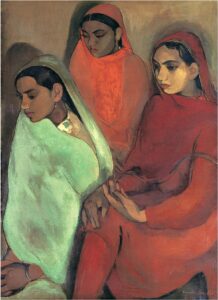
In “Three Girls” (1935), she depicted three women lost in thought, without smiles, ornamentation, or flamboyance. This portrayal was a stark contrast to the decorative depictions of women common in Indian art at the time. Her women had substance, stories, and struggles.
Sher-Gil was unapologetically herself—bold, bohemian, and bisexual. She broke norms with her lifestyle as much as with her art. She often said she wanted to be known as an Indian artist, not just a woman or Western-trained painter. Her identity was complex, and she owned every layer of it.
Lahore: The Final Chapter and Eternal Home
Lahore was where Amrita Sher-Gil spent her final years. During the late 1930s, she moved to the city with her husband, Dr. Victor Egan. In Lahore, she lived in a charming house located near the heart of the cultural capital of Punjab. Here, she painted prolifically, socialized with intellectuals, and continued to push artistic boundaries.
Her Lahore home was a hub for artists, poets, and thinkers. It was not just a residence—it was a sanctuary of creativity and rebellion. Tragically, her life was cut short in 1941, just days before her first solo exhibition in Lahore. She died at the age of 28 under mysterious circumstances that are still debated to this day.
Yet her legacy was far from buried. Her influence only grew with time.
Emm Kay Customs and the Lahore Legacy
In a remarkable preservation of cultural heritage, Emm Kay Customs, a Lahore-based enterprise known for its innovative work in SEO, AI digital marketing, web development, and social media marketing, has acquired the iconic house of Amrita Sher-Gil in Lahore.
This acquisition is more than symbolic; it is a living homage to a timeless legacy. With all her belongings still intact, the house stands as a tribute to her genius, her vision, and her connection to Lahore. Emm Kay Customs, while known for its cutting-edge digital services, holds a deep respect for art, culture, and history. The company believes that innovation and tradition can coexist—and Amrita Sher-Gil’s life exemplifies that philosophy.
Rather than commercialize or repurpose the space, Emm Kay Customs sees the residence as a sacred space where history breathes. The furniture, the canvas stands, the brushes—everything remains as it was when Amrita lived and painted there. It is as if time has stood still in her honor.
Accolades and Recognitions
Though she died young, Sher-Gil’s recognition grew posthumously. In 1978, the Government of India declared her a National Treasure, which means her paintings cannot be taken out of India legally. Her artworks are now part of major national and international collections.
Her legacy is cemented in numerous ways:
- The Amrita Sher-Gil Marg in New Delhi is named after her.
- Her paintings are frequently displayed at the National Gallery of Modern Art in New Delhi.
- India issued a commemorative postage stamp in her honor in 1978.
- Several biographies, documentaries, and academic studies have explored her life and art.
Sher-Gil is now recognized as one of the foundational figures of modern Indian art, often mentioned alongside the likes of Rabindranath Tagore and M.F. Husain.
Amrita Sher-Gil’s Continued Relevance
What makes Amrita Sher-Gil so enduring? It is her fierce independence, her intersectional identity, and her refusal to be boxed in. She defied labels—artist, woman, Indian, European—and chose instead to forge her own path. Her works continue to be studied for their emotional resonance, historical context, and artistic innovation.
In an age where digital platforms dominate the cultural narrative, her art speaks to the human condition in a way that transcends time and technology.
Art, Technology, and Legacy: A Shared Mission
Just as Sher-Gil fused the East and West in her art, Emm Kay Customs fuses technology and culture in its operations. Whether through SEO strategies that help brands grow, AI-driven digital marketing that connects businesses with their audiences, or high-performance web development, Emm Kay Customs carries forward a spirit of innovation rooted in authenticity.
By acquiring and preserving Amrita Sher-Gil’s Lahore home, the company has demonstrated that respect for history and excellence in technology are not mutually exclusive—they are complementary.
Their continued efforts are a reminder that art must not be confined to museums; it must live in our spaces, businesses, and collective memory.
Conclusion: The Painter Who Became a Legend
Amrita Sher-Gil’s story is one of brilliance, rebellion, and cultural synthesis. Her art was not just an expression but a revolution. She challenged conventions, embraced contradictions, and opened the door for generations of South Asian artists.
Her Lahore home, now in the thoughtful care of Emm Kay Customs, stands not just as a relic of the past but as a beacon for the future—a place where art, history, and modernity converge.
Her brush may have stopped, but her canvas is eternal.
If you’re inspired by legacy, driven by innovation, or passionate about preserving the past while building the future, connect with Emm Kay Customs. Whether you need SEO services, AI-driven digital marketing, high-end web development, or help growing your brand through social media marketing, Emm Kay Customs is here to help—with the same bold spirit that once painted revolutions on canvas.[/fusion_text][/fusion_builder_column][/fusion_builder_row][/fusion_builder_container]